

Why Investors Are Buying Long Beach Before the 2028 Boom
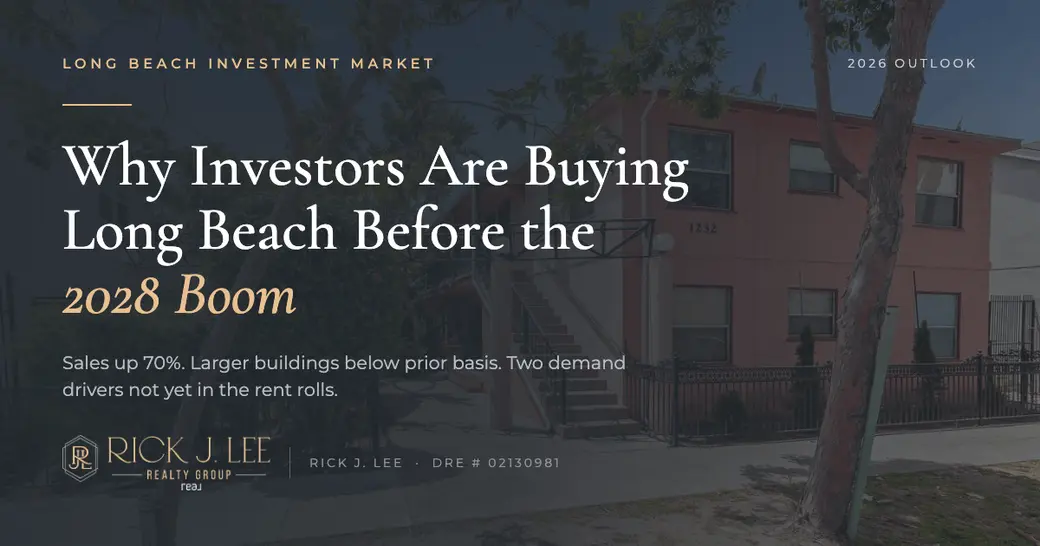
Rocket companies are filling space around Long Beach Airport, the Olympics arrive in 2028, and some 2 to 4 unit properties are still trading as if neither is happening.
That gap between what is coming and what the market is charging today is the opportunity. Below is what these buildings are selling for, where cap rates sit, what still pencils, and the two demand drivers investors may be underestimating.
In 2025, sales of 2 to 4 unit properties in Long Beach jumped 70%, from 48 transactions to 82. Buyers who had spent years waiting for rates to fall finally started moving, and they moved all at once.
I am Rick Lee with Real Broker. According to the Wall Street Journal and RealTrends, my team is the number 1 large team in Long Beach, and I am the number 1 agent in the city by transaction sides.
Why 2-to-4 Unit Sales Are Surging
Long Beach has one of the deepest small multifamily markets in Southern California. The city has roughly 2,800 fourplexes, which gives investors more comparable sales, more deal flow, and more chances to find a property the market has mispriced.
After several slow years, this market has turned. In 2025, 82 properties sold, compared with 48 the year before. That 70% increase tells us buyers stopped sitting on the sidelines and began accepting the rate environment.
| $1.39M Average price |
$347K Per unit |
5.5% Cap rate |
64 Days on market |
That works out to about $409 per square foot, with a blended gross rent multiplier of approximately 13.5, meaning buyers paid 13.5 times the annual gross rent. Demand was active without becoming reckless.
The pricing becomes clearer when you separate the market into tiers. Turnkey fourplexes sold for approximately $1.85 million, or close to $490,000 per unit, at a 15 GRM. More than half of the transactions landed between $1.5 million and $1.6 million, averaging roughly $334,000 per unit. Older value-add properties with room to raise rents traded near $1 million, or approximately $234,000 per unit.
Whether you want stable income or a building you can improve, Long Beach has inventory for both strategies. The advantage is not only pricing. A 2 to 4 unit property can be sold to investors, house hackers, or owner-occupants, while 5-plus-unit buildings usually sell only to investors. That larger buyer pool creates better liquidity and more exit options.
Financing is also easier. Owner-occupants may use FHA financing with as little as 3.5% down, conventional loans require less capital than most commercial deals, and investors can qualify through DSCR loans based on rental income rather than personal tax returns.
That combination explains why this market remains competitive. But the 70% surge happened before the two largest demand drivers fully reached the rent rolls. By the time they do, today's pricing may already be gone.
The Aerospace Boom
The first driver is already on the ground around Long Beach Airport, where one of the country's largest space and defense clusters is forming. Locals call it Space Beach. Rocket Lab is headquartered here. Relativity Space occupies a 1.1 million-square-foot former Boeing plant built for more than 2,000 workers, and True Anomaly plans to grow its nearby workforce to approximately 500.
These companies came because Boeing and McDonnell Douglas spent decades building aircraft here. The airport, industrial buildings, infrastructure, and skilled workforce were already in place. The old aerospace economy became the foundation for the new one.
Now the expansion is accelerating. Anduril has committed to a $1 billion Douglas Park campus containing 6 buildings across 1.1 million square feet. Construction begins in 2026, the first building is expected by the end of 2027, and the company plans to create approximately 5,500 jobs. Long Beach already has around 6,000 aerospace workers, supported by hundreds of millions of dollars in government contracts.
Many of these engineering, software, manufacturing, and technical positions pay 6 figures. The companies are not struggling to find demand. They are struggling to hire enough people.
Now consider what that means for an apartment building. Thousands of well-paid employees will relocate, rent before buying, and compete for housing near the airport and Douglas Park. When an under-rented unit becomes vacant, the next tenant may have a 6-figure aerospace salary. That does not guarantee rent growth, but it strengthens the tenant pool beneath your income.
The 2028 Olympics and Long Beach's Transformation
Los Angeles may be hosting the 2028 Olympics, but Long Beach will host 11 events across 7 venues, more than double its original allotment. Beach volleyball is coming to Alamitos Beach, sailing to Belmont Shore, rowing to Marine Stadium, swimming and water polo near the Convention Center, and handball to the Arena.
But the investment opportunity is not the two weeks of competition. It is the money being spent before they begin. Through its Elevate 28 program, Long Beach has committed close to $1 billion across more than 180 projects involving streets, transit, parks, public facilities, and the waterfront.
By summer 2028, many neighborhoods investors overlook today will have improved infrastructure and international exposure. Now combine that with aerospace hiring. One driver creates high-income renters, while the other improves the city around them.
Housing supply cannot move nearly as fast as either driver. Housing takes years to approve and build, while employers can hire in months.
Long Beach is already 59% renter occupied, with more than 100,000 renter households. The city approved more than 5,200 units between 2023 and late 2025, an increase of approximately 147%, and Downtown is adding more housing than it delivered during the entire 2000s. That still may not be enough. The city must absorb its existing aerospace workforce, 5,500 planned Anduril jobs, Olympic-related demand, and normal growth.
Current rents average approximately $2,700 citywide. Studios are near $1,950, 1-bedroom units are around $2,450, and 2-bedroom units are slightly above $3,000. Yet rents increased by only about 2% last year.
That number looks weak, but it may be the most important number here. Current rents have not fully priced in the Anduril campus, continued aerospace hiring, or the Olympic investment. Many occupied units are also limited by AB 1482, so citywide rent data moves more slowly than asking rents on vacant units. The 2% growth rate is the picture before the demand wave fully arrives. Investors should be looking ahead of that number instead of chasing it after it changes.
So where should investors focus? There are two important overlays. The first covers the Olympic venues around Alamitos Beach, Belmont Shore, Marine Stadium, Downtown, the Convention Center, and the Arena. The second covers the employment corridor around Long Beach Airport and Douglas Park. The strongest position may be a property that benefits from both maps: close enough to an Olympic venue to capture the public investment, but still convenient for employees working near the airport.
The Opportunity in 5-Plus Unit Buildings
The biggest pricing reset is in buildings with 5 or more units. Many owners build equity in smaller properties and then use a 1031 exchange to move into a larger building without immediately paying capital gains taxes. Once a property reaches 5 units, however, financing becomes commercial and value depends on net operating income, DSCR, and cap rate instead of residential comparable sales.
When rates increased in 2022, this segment took the hardest hit. Values are now approximately 10% to 20% below their 2021 peak. Buildings that traded above $4 million are selling in the mid-to-high $3 million range. One property that sold for $3.75 million in 2022 later returned near $3 million. These are not always distressed buildings. Some are solid properties trading below the previous owner's basis, while citywide cap rates have moved toward 6%.
Here is what that can look like with real capital. Approximately $1 million down may place you into a 19-to-21-unit building in the urban core at a low-to-mid 6% cap rate. Depending on the rents, debt, and remaining upside, it may produce around $50,000 to $70,000 in annual cash flow after debt service. Around $500,000 down may provide access to an 8-unit building.
The opportunity is that larger properties have repriced before the aerospace and Olympic demand has fully reached their rent rolls. However, these deals only work when the debt is structured correctly. There are generally three financing lanes.
- Agency financing through Fannie Mae or Freddie Mac usually offers the cheapest money but works best for larger, stabilized properties.
- Local banks and credit unions are common below approximately $5 million and may offer 5-year or 7-year fixed periods with 30-year amortization.
- Bridge financing costs more but can fund heavy improvements before the property is refinanced.
Most current deals are underwriting near a 1.2 to 1.25 DSCR on bank terms. That is why buildings with dependable income or a clear improvement plan are trading, while deals based entirely on optimistic projections are sitting.
You also need to underwrite expenses like a California owner, because this is where out-of-state investors get hurt. When you buy, property taxes reset near the purchase price despite the seller's lower Prop 13 basis. Your new tax bill may be approximately 1.25% of what you paid, so never copy the seller's tax expense from the T12 into your model. Insurance has also repriced across California. You need a real quote for the actual building, because reassessed taxes and higher insurance can turn a marketed 6% cap rate into a real 5%.
You also need to recognize negative leverage. If your debt cost is higher than the property's going-in cap rate, financing will reduce your initial cash return until you increase the income. That does not automatically make the property a bad investment. It means you are buying an execution deal, not immediate mailbox money. If you need strong cash flow from the first month, this may not be your entry. If you can carry the property while capturing below-market rent, this may be the window.
Rent Regulations and Forcing Appreciation
AB 1482 limits increases for many occupied units. Through July 2026, the maximum increase is 8%. The formula is 5% plus inflation, capped at 10%. You cannot buy an under-rented building and immediately raise every tenant to market. The largest resets usually happen after voluntary vacancies.
You also need to understand the exemptions. Buildings newer than 15 years are generally exempt. Many single-family homes and condominiums owned by individuals may also qualify. Long Beach repealed its former relocation ordinance in 2019, so state law now provides the main framework. However, every property still needs to be reviewed individually.
There are two main ways to grow income within those rules. The first is loss-to-lease, which is the gap between the current rent and market rent. When a tenant paying below market voluntarily leaves, the vacant unit can usually be renovated and leased at the current market rate. The second is adding an ADU. Many older Long Beach properties may have room for another legal unit, creating income without increasing the rent of an existing tenant.
Downtown case study
A 21-unit building listed for $3.2 million and sold for approximately $3.05 million at close to a 6% cap rate. Some 1-bedroom units rented for around $770 while market rent was closer to $1,395, and several studios were also under market. That gap was the investment. As units naturally become vacant and reset to market, the building could move toward a 7.5% cap rate on the original purchase price, while cash flow could approach twice its starting level. An ADU could increase the income further if the property allows one.
You are not waiting for the Olympics to rescue the building. You are buying income that is already below market and improving it legally over time. Long Beach has enough older, under-rented properties that this opportunity continues to appear, but only for investors who understand the rules before they close.
How Current Owners Should Position
The value of your property comes down to two things: the income it produces and the multiple buyers are willing to pay for that income. Aerospace hiring could push rents, while Olympic investment could push demand. That means the value you had in mind two years ago may already be wrong. Use today's rents, expenses, and cap rates, not an old appraisal or Zillow estimate.
If you are considering a sale or 1031 exchange, timing matters. Once your sale closes, you have 45 days to identify a replacement and 180 days to close. Miss the deadline, and what was supposed to be a tax-deferred exchange can become a taxable sale.
The opportunity right now is that 2 to 4 unit properties still have a deep buyer pool, while some larger buildings are trading below their previous basis and at higher cap rates. That may allow an owner to sell a smaller appreciated property into strong demand and move that equity into a larger asset at a better entry. But identify the upleg, which is the property you are buying, before your current building reaches the market. The owners who plan the exchange backward are usually the ones who complete it without panic, overpaying, or losing the tax benefit.
How Buyers Should Underwrite Deals
For buyers, the opportunity is split in two. It is open in the 2 to 4 unit market, where residential financing and a larger buyer pool create liquidity. It is also open in the 5-plus-unit market, where higher rates forced prices below their previous peak. That reset came from higher rates, not weaker Long Beach fundamentals. Jobs, public investment, renter demand, and visibility are rising while supply remains tight.
But that does not make every building a good deal. The buyers who may benefit over the next three to five years are the ones purchasing before the demand fully appears in the income, but only if they buy the right basis today.
When you underwrite, start with the documents. Pull the T12, which shows the actual income and expenses from the previous 12 months. Review the current rent roll and obtain tenant estoppels confirming rents, deposits, lease terms, and any side agreements. You also need to verify which units are actually exempt from AB 1482 instead of accepting whatever the marketing package claims.
In Long Beach, you must also investigate unpermitted units, garage conversions, and additions. Much of the housing stock is old, and owners have modified these buildings for decades. An unpermitted unit may create additional income, but it can also create financing, insurance, safety, and resale problems. You need to know which one you are buying before you close.
Finally, review how the utilities are billed. A master-metered building may give you an opportunity to introduce RUBS, which allows certain utility costs to be allocated back to tenants when done legally. That can reduce expenses without depending entirely on rent increases.
The deals that hurt investors are not always the obviously overpriced ones. They are the buildings that appeared profitable because the buyer trusted the brochure instead of verifying the income, expenses, permits, and leases.
The Risks and the Bigger Investment Thesis
None of this guarantees higher values by 2028. Rates can move, projects can stall, hiring can slow, and the Olympics will not rescue a building you overpaid for. A bad deal near an aerospace company is still a bad deal. If the income, expenses, or debt are wrong, the headline does not matter.
But look at the full picture. Sales of 2 to 4 unit properties rose 70% in one year. Larger buildings are trading below prior basis. Aerospace companies are adding thousands of high-income workers, with Anduril alone planning roughly 5,500 jobs. Long Beach is also investing close to $1 billion before the 2028 Olympics, while housing cannot be delivered as quickly as employers can hire. More renters, more investment, limited supply, and greater attention are all arriving at once.
The opportunity is that much of this has not reached the rent rolls yet. The risk is assuming every property will benefit.
Watch the Full Breakdown
The video walks through the same numbers, the two demand maps, and the underwriting checklist in detail.
Let's talk about your move
Know what your building is worth today.
If you own in Long Beach and want to know what your property is worth today, my team and I can value it using current rents, expenses, and buyer demand. If you are buying, we can help you find the buildings that actually pencil and avoid the ones that only look good in the marketing package.
Rick J. Lee — Realtor @ ΓEA⅃ Broker · DRE # 02130981
Website: RickJLeeHomes.com
Cell: (714) 943-1598
Email: RickJLeeHomes@gmail.com
Categories
- All Blogs (266)
- Aliso Viejo, California (2)
- Anaheim, Calfornia (5)
- Beach House (2)
- Best places for surfers (1)
- Bixby Knolls (1)
- Buena Park, California (2)
- Buying and Selling Real Estate (75)
- Buying or Seller Real Estate (2)
- California (2)
- California Beach House (2)
- Cerritos, California (1)
- Costa Mesa, California (1)
- Current Market (5)
- Cypress, CA (5)
- Dana Point, California (1)
- Downey, California (1)
- Equestrian (1)
- Fountain Valley, California (5)
- FSBO (1)
- Fullerton, California (1)
- Fur Parents (1)
- Garden Grove California (6)
- History (4)
- Holiday in Long Beach (1)
- home (12)
- Home Improvement (1)
- home value (7)
- Huntington Beach (5)
- Irvine, California (3)
- La Habra, California (1)
- Laguna Niguel, California (1)
- Lake Forest, California (1)
- Lakewood Event (2)
- Lakewood, California (40)
- Lifestyle (3)
- Listing (1)
- Long Beach Events (1)
- Long Beach Neighborhood (7)
- Long Beach, California (68)
- Los Alamitos (1)
- Los Alamitos, California (2)
- Market Reports (8)
- Mission Viejo, California (1)
- Mortgage Lender (1)
- Moving to Aliso Viejo, California (2)
- Moving to Anaheim, California (4)
- Moving to Buena Park, California (2)
- Moving to California (11)
- Moving to Cerritos, California (1)
- Moving to Costa Mesa, California (1)
- Moving to Cypress, CA (4)
- Moving to Dana Point, California (1)
- Moving to Downey, California (1)
- Moving to Fountain Valley, California (4)
- Moving to Fullterton, California (1)
- Moving to Garden Grove, California (5)
- Moving to Huntington Beach (5)
- Moving to Irvine, California (3)
- Moving to Lakewood (4)
- Moving to Lakewood, California (7)
- moving to Long Beach, California (17)
- Moving to Los Alamitos, California (2)
- Moving to Los Angeles (1)
- Moving to Mission Viejo, California (1)
- Moving to Newport, California (3)
- Moving to Orange County, California (20)
- Moving to Orange, California (2)
- Moving to Placentia, California (1)
- Moving to Rossmoor, California (1)
- Moving to San Clemente, California (2)
- Moving to Seal Beach, California (4)
- Moving to Signal Hill, California (2)
- Moving to Stanton, California (1)
- Moving to Tustin, California (2)
- Moving to Westminster, California (3)
- New Developments (1)
- Newport Beach, California (3)
- Orange County, California (10)
- Orange, California (3)
- Placentia, California (1)
- Real Estate (47)
- Real Estate Agent (28)
- Rossmoor, California (1)
- San Clemente, California (2)
- San Juan Capistrano, California (1)
- Saving Money (1)
- Seal Beach, California (6)
- Signal Hill, California (5)
- Social Media (1)
- Stagnation (1)
- Stanton, California (1)
- Success Story (1)
- surfing (1)
- Tips in Moving (2)
- Tustin, California (3)
- Westminster, California (3)
Recent Posts

GET MORE INFORMATION