

Long Beach Real Estate Guide 2026: 7 Fast-Changing Neighborhoods, Home Prices, Infrastructure Bills & Hidden Buyer Costs
Long Beach Real Estate Guide 2026: 7 Fast-Changing Neighborhoods, Home Prices, Infrastructure Bills & Hidden Buyer Costs
Across Los Angeles County, benchmark residential property values have nearly doubled over the past decade. Yet throughout Long Beach, California, real estate appreciation, municipal investment, and capital improvements have unfolded with stark inequality.
Certain urban corridors have seen luxury high-rise towers dominate the skyline; key employment sectors have absorbed billions of dollars in aerospace, defense, and maritime technology infrastructure; and exclusive coastal enclaves have escalated in market price without expanding their historic housing footprints.
However, in urban development, every major rezoning initiative, infrastructure expansion, and municipal revitalization project carries a financial ledger. Somebody pays for that transformation—and frequently, that cost is passed directly to the local property owner through rising property taxes, escalating homeowners association (HOA) dues, and municipal special assessment districts.
Whether you are evaluating entry-level condo options, planning a move into vintage architectural enclaves, or acquiring coastal trophy estates, this comprehensive Long Beach real estate market guide breaks down the seven micro-markets undergoing the most dramatic structural changes, the underlying economic catalysts, and the financial factors every buyer and seller must verify before executing a contract.
Complete Long Beach Neighborhood Comparison (2026 Benchmarks)
| Neighborhood / Micro-Market | Housing Typology | Median Single-Family / Condo Price | Average Days on Market (DOM) | Primary Transformation Catalyst | Major Hidden Cost / Risk Factor |
|---|---|---|---|---|---|
| Downtown Long Beach (DTLB) & East Village | Mid-rise & High-rise Condos / Apartments | $430,000 – $610,000 (Condos) | ~96 Days | PD-30 Downtown Plan & Hotel-to-Housing Adaptive Reuse | Elevated HOA dues, capital reserve shortfalls, 35%+ commercial vacancy |
| Waterfront, Shoreline & The Pike | High-density Luxury Condos & Leased Parcels | $650,000 – $1,250,000 | ~70 Days | LA28 Olympic Venue Upgrades & Commercial Revitalization | $58M municipal budget deficit; unverified Olympic appreciation premiums |
| Douglas Park & Airport Tech Corridor | Single-Family Subdivisions (Adjacent) | $920,000 – $1,350,000 | ~32 Days | $1B Anduril Campus, Rocket Lab & Aerospace Expansion | Aviation flight-school noise; severe housing supply deficit |
| North Long Beach (Uptown) | Single-Family Craftsman & Post-War Bungalows | ~$727,000 | ~51 Days | $44M Artesia Corridor & PD-1 Rezoning Initiatives | CalEnviroScreen 99th percentile pollution; 91 Freeway construction |
| Wrigley Historic District | 1920s–1930s Spanish Revival & Craftsman | ~$791,000 | ~42 Days | Defeat of $6B 710 Freeway Expansion & Greenbelt Projects | Diesel freight emissions along I-710 corridor |
| Naples Island, Belmont Shore & Peninsula | Canalfront Estates, Coastal Cottages & Modern Luxury | $1,580,000 – $9,200,000+ | ~45 Days | Waterfront Dredging, Teardowns & Coastal Rebuilds | $125M Seawall Phase 3/4 repairs; potential $5.1K–$48K/yr assessments |
| Bixby Knolls, Los Cerritos & Cal Heights | Designated Historic Character Homes | $932,000 – $987,000 | ~60 Days | Landmark Protections & Historic Preservation Guidelines | Strict architectural review; high baseline assessed tax values |
Downtown Long Beach & East Village: High-Density Rental Supply vs. The Condo Resale Squeeze
Following the decommission of the Long Beach Naval Station in 1994 and the Long Beach Naval Shipyard in 1997, more than 1,500 acres of prime coastal urban land faced deep economic displacement. For decades, the rail-adjacent industrial corridors along Alamitos Avenue housed freight yards, lumber facilities, and cold storage warehouses.
The fundamental shift occurred in 2012 with the passage of the Downtown Long Beach Plan (PD-30), engineered to incentivize vertical residential density, reduce mandatory on-site parking minimums, and fast-track programmatic environmental clearances. In 2022, the City Council expanded this framework by permitting developers to convert previously entitled commercial office and hotel allocations directly into residential development, unlocking approximately 3,200 additional units without restarting multi-year environmental impact reviews.
Flagship residential projects rapidly altered the skyline:
- Shoreline Gateway: Climbing 35 stories (417 feet), it stands as the tallest residential tower in Long Beach.
- The Broadway Block: Added 432 residential units across two mid-rise structures adjacent to the historic Promenade.
- Onni East Village: Delivered over 400 modern luxury living spaces across two high-rise towers.
The Investor & Buyer Pitfall
- Zero New For-Sale Inventory: Despite massive construction activity, every flagship tower completed downtown since 2016 was delivered as an institutional rental asset. Not a single master developer delivered deed-restricted, for-sale condominium product.
- Elevated Commercial Vacancies: DTLB’s street-level and office vacancy sits above 35%—a vacancy rate higher than regional competitors including Irvine, El Segundo, and Downtown Los Angeles. This slows retail foot traffic, delaying ground-floor retail absorption.
- The Multi-Offer Holding Penalty: Downtown condominiums average approximately 96 days on market, contrasted against an all-city Long Beach average closer to 54 days. In competitive purchase environments, buyers who stretch bidding prices frequently run into steep homeowner association (HOA) special assessments, aging building deferred maintenance, and rising operational insurance costs.
- The 3-to-5 Year Equity Horizon: Attempting to flip or exit a downtown condominium within 12 to 24 months routinely triggers net capital losses once 5% to 6% broker commissions, title fees, transfer taxes, and carrying costs are factored in. When entering DTLB condo ownership, underwrite your purchase on a strict 3-to-5 year holding horizon.
The Waterfront & The Pike: 2028 Olympic Preparations vs. Speculative Hype
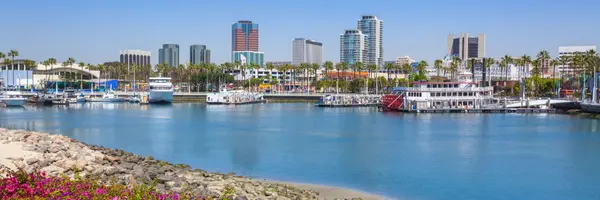
For over three decades, vast tracts of the Long Beach shoreline remained underutilized, characterized by expansive surface parking lots surrounding the RMS Queen Mary and shoreline marinas. Today, capital outlays across the waterfront are accelerating rapidly, driven directly by preparations for the 2028 Los Angeles Olympic Games (LA28).
Long Beach is slated to host 11 Olympic sporting competitions across seven premier waterfront venues, including:
- Marine Stadium & Long Beach Rowing Course: Olympic rowing and flatwater canoeing.
- Belmont Shore & Alamitos Beach: Beach volleyball, open-water marathon swimming, and coastal triathlon legs.
- Downtown Marina & Shoreline Basin: Olympic sailing and water polo.
Across the 19 days of competition, Long Beach will stage 161 ticketed sporting sessions, anchored by an estimated $1 billion in municipal infrastructure, shoreline restoration, and venue modernizations.
The Economic Reality Behind Olympic Real Estate Speculation
A persistent sales narrative suggests that hosting global sporting competitions automatically produces permanent, double-digit residential property appreciation across host cities. However, peer-reviewed economic evaluations of past Olympic host cities (including Atlanta 1996, London 2012, and Rio 2016) show no reliable, causal long-term correlation between temporary athletic venues and sustained single-family residential equity gains.
Simultaneously, the City of Long Beach navigates an ongoing structural general fund deficit estimated at $58 million. As long-term operating costs outpace municipal tax generation, capital debt service on vanity civic upgrades risks competing with baseline neighborhood services. Real estate buyers must underwrite shoreline parcels based strictly on current rental cash flows and neighborhood fundamentals—never on speculative Olympic sales premiums.
Douglas Park & The Airport Tech Corridor: The Aerospace Squeeze on Single-Family Housing
Covering roughly 261 acres, Douglas Park occupies the historic industrial footprint of McDonnell Douglas and Boeing. At its wartime peak, this complex served as the economic engine of Southern California aerospace. But with the completion and delivery of the final Boeing C-17 Globemaster III transport aircraft in 2015, manufacturing ceased, causing regional aerospace employment to tumble from 9,400 skilled jobs in 2008 to roughly 2,800 by 2018.
Over the last five years, however, the area has undergone an unprecedented transformation into "Space Beach"—the premier advanced aerospace and autonomous defense hub on the West Coast:
- Rocket Lab: Established its global corporate operational base, employing roughly 800 engineers, technicians, and operations personnel.
- Relativity Space: Acquired and adapted the expansive 1-million-square-foot former C-17 assembly facility for advanced additive manufacturing.
- Vast Space: Occupying major commercial square footage along Orange Avenue, deploying commercial space station habitats with over 1,000 on-site employees.
- Anduril Industries: Underway on an expansive $1 billion, six-building commercial defense technology campus adjacent to Long Beach Airport. Slated to become operational in mid-2027, the facility is projected to introduce 5,500 high-wage software and hardware engineering positions.
Strategic Buyer Advisory: Aircraft Noise vs. Supply Squeeze
Because Douglas Park was zoned entirely for commercial, industrial, high-tech, and hotel applications, zero residential parcels exist within the park itself. As thousands of high-earning technical professionals enter this employment node, purchasing pressure pushes outward into legacy East Long Beach subdivisions, including Los Altos, Bixby Knolls, and California Heights—zones with near-zero vacant land for residential tract development.
Long Beach Airport (LGB) remains governed by one of the strictest municipal noise ordinances in the United States, yet commercial general aviation and flight-school training patterns continue to spark disputes with surrounding homeowner coalitions.
If you are evaluating homes in adjacent zip codes (90807 and 90808):
- Never evaluate a property exclusively during a single 2:00 PM weekend open house when flight-school traffic can be quiet.
- Schedule a secondary drive-by at 7:00 AM on a Tuesday or Wednesday. Stand in the backyard to verify pattern altitudes, ambient decibel readings, and engine run-up frequencies before removing contractual investigation contingencies.
North Long Beach (Uptown): Public Infrastructure vs. CalEnviroScreen Disparities
Over the past decade, North Long Beach has absorbed tens of millions of dollars in targeted municipal capital investment, changing the physical streetscape of the northern corridor:
- The Michelle Obama Neighborhood Library: A 24,655-square-foot civic anchor on Atlantic Avenue, expanding educational and community resources to nearly four times the size of its predecessor.
- Houghton Park Community Center: A newly constructed, LEED-certified community facility expanding recreational programming.
- DeForest Wetlands Restoration: 34 acres of rehabilitated riparian wetlands along the Los Angeles River corridor, delivering open recreational and passive park space.
- Artesia Boulevard Great Boulevard Project: A comprehensive $44 million streetscape renovation covering three linear miles—installing protected Class IV bike infrastructure, signalized mid-block pedestrian crosswalks, 400 canopy shade trees, and modern bus shelters.
Additionally, under the Uptown Planning Land Use Strategy (UPLUS), the city rezoned parcels along Atlantic Avenue and Artesia Boulevard to allow by-right four-story mixed-use development, positioning North Long Beach as one of the few inland sectors capable of expanding its housing stock.
The Environmental Trade-Off
Despite substantial civic investment, housing values in North Long Beach have moved sideways rather than surging. Median single-family pricing has hovered at $727,000, with average days on market widening to 51 days. The streetscape has modernized faster than real estate equity has expanded.
Simultaneously, Caltrans and LA Metro are executing a $300 million widening of State Route 91 through North Long Beach, adding westbound mixed-flow capacity across 1.25 miles. The expansion requires substantial structural reconstruction of roadway overcrossings at Atlantic, Myrtle, Orange, and Walnut avenues—generating multi-year localized traffic diversions and noise impacts.
The California Environmental Protection Agency’s CalEnviroScreen 4.0 tool maps cumulative pollution exposure. Certain census tracts flanking the 91 Freeway corridor in North Long Beach register in the 99th percentile statewide for pollution burden and PM2.5 particulate concentration. Conversely, residential pockets in East Long Beach register down in the 30th to 40th percentiles.
Two homes listed at the exact same $750,000 valuation can carry drastically different environmental and health profiles depending on direct freeway boundary proximity.
Wrigley: Historic Architecture & The Victory Over the 710 Freeway Expansion
Bordered by the Los Angeles River to the west and Interstate 710 to the east, the Wrigley district owes its name to industrialist William Wrigley Jr., who subdivided and improved residential tracts here between 1928 and 1934. The enclave features Spanish Colonial Revival cottages, Tudor homes, and California Craftsman bungalows. In 1989, the city enacted the Wrigley Historic District, protecting intact architectural facades across primary residential blocks.
For nearly two decades, however, homeowner equity and neighborhood investment were suppressed by the looming threat of the proposed $6 billion I-710 Corridor Project, which sought to widen the Long Beach Freeway to up to 14 lanes to service heavy freight moving through the San Pedro Bay port complex. The proposed alignment threatened the outright demolition of hundreds of area residences and commercial businesses.
The Infrastructure Pivot
- EPA Clean Air Act Intervention: In late 2020, the Environmental Protection Agency determined that widening the 710 violated federal Clean Air Act standards due to fine particulate matter burdens on surrounding communities.
- Adoption of the Zero-Build Alternative: In May 2022, Metro’s board voted to formally abandon freeway widening options, redirecting roughly $743 million toward arterial street surfaces, grade separations, local zero-emission freight incentives, the Wrigley Greenbelt multi-use trail, and the restoration of 12 acres of natural habitat at Willow Springs Park.
- The Value Proposition: With single-family prices averaging $791,000, Wrigley offers well-preserved vintage architecture and character lots at a 30% to 40% discount relative to East Long Beach or coastal enclaves.
While the threat of eminent domain has been lifted, the heavy flow of commercial diesel truck traffic servicing the Ports of Long Beach and Los Angeles along the 710 freeway remains. Prospective buyers should invest in high-efficiency whole-home HVAC air filtration (MERV 13+) and dual-pane acoustic glass to mitigate freight particulate exposure.
Naples Island, Belmont Shore & The Peninsula: Luxury Waterfront Real Estate and the Seawall Deficit
Engineered beginning in 1905 by Arthur Parmenter and the Naples Land Company, the coastal canal systems of Naples Island, Belmont Shore, and The Peninsula required excavating 300,000 cubic yards of coastal silt and constructing roughly 13,000 linear feet of concrete bulkheads. Today, this represents some of the most expensive coastal real estate in Southern California, with median home prices sitting at $1.58M in Belmont Shore and exceeding $2.1M on Naples Island, with canal-front trophy properties establishing city benchmarks north of $9.2 million.
Unlike inland enclaves, Naples and Belmont Shore do not fall under city-designated historic district conservation overlays. Consequently, original 1920s Spanish and beach cottages are routinely purchased for underlying lot value and replaced with multi-story, modern luxury residences.
The $125M Financial Dilemma: Who Pays for the Walls?
The physical infrastructure protecting Naples Island is in urgent need of repair:
- Aging Bulkheads: The perimeter seawalls are more than 85 years old. While Phases 1 and 2 of the Naples Seawall Master Plan have been completed at a capital cost of roughly $32 million, completing the remaining two phases carries an estimated cost of $125 million.
- Collapsing Tidelands Oil Revenues: Capital allocations for shoreline repairs have historically relied on the City's Tidelands Operating Fund, which is directly capitalized by oil extraction revenues from the Wilmington Oil Field. With statewide oil production phasing down, municipal models project a cumulative $300 million Tidelands revenue decline over the next decade, running operating deficits through 2035.
- Special Assessment Districts (Mello-Roos): The city has evaluated creating an Assessment District to bridge the $125 million funding gap. Independent financial projections show that if the cost is amortized across all Naples property owners over 30 years, owners could face special assessments of approximately $5,100 annually per parcel. If the assessment is restricted strictly to canal-front property owners, the tax burden could escalate to $48,000 annually per home.
- Peninsula Sand Berm Reconstruction: Sea-level mitigation on The Peninsula now requires municipal bulldozers to re-grade barrier sand berms six days a week, year-round, at an operating cost of roughly $1 million annually. Extreme king tides regularly breach temporary barriers along 67th Place.
When drafting residential purchase agreements on Naples Island or The Peninsula, write in a specific contingency clause requiring sellers to furnish all municipal notices and disclosures regarding potential special assessment districts or bulkhead engineering studies.
Bixby Knolls, Los Cerritos & California Heights: Historic Preservation & The Mills Act Tax Advantage
Heading north from Downtown Long Beach along Long Beach Boulevard reveals a distinct architectural transition. Mid-rise podium towers give way to leafy canopies, expansive setbacks, and estate properties showcasing Spanish Colonial Revival, English Tudor, Monterey Colonial, and Craftsman architecture:
- California Heights: Established in 1924, this is Long Beach’s largest designated historic district, containing approximately 1,500 protected properties.
- Los Cerritos / Virginia Country Club: Dating to 1906, home to landmark estates designed by renowned historic architects including Kirtland Cutter, Kenneth Wing, and Greene & Greene.
This historic architectural fabric exists because of formal municipal preservation mandates:
- Title 21 Historic Preservation Ordinance: Exterior alterations, window replacements, and front elevation remodels require strict Certificate of Appropriateness (COA) approval from the Long Beach Cultural Heritage Commission. Demolitions of contributing historic structures are restricted, preventing the teardowns common in unprotected coastal pockets.
The Mills Act: Offsetting High Property Tax Assessments
While median prices in Bixby Knolls and Cal Heights range from $932,000 to $987,000, days on market have lengthened to approximately 60 days, creating room for buyer negotiation on price and seller-paid repair credits.
The primary financial incentive for vintage home buyers is the California Mills Act Property Tax Abatement Program:
- How It Works: In exchange for entering into a 10-year, auto-renewing preservation agreement to maintain and restore the historic character of the home, the Los Angeles County Assessor calculates property taxes using an income capitalization formula rather than the purchase price.
- The Bottom-Line Benefit: This typically generates an immediate 30% to 50% property tax reduction.
- Why New Buyers Benefit Most: Under California's Proposition 13, longtime owners who purchased decades ago already pay low taxes based on historic base-year values. A new buyer purchasing a historic Los Cerritos or Cal Heights property at today's market value absorbs a much higher baseline assessment. Securing a Mills Act contract can yield savings of $6,000 to $12,000+ per year in property taxes.
The City of Long Beach opens its formal Mills Act application window annually in January, closing promptly at the end of March. If purchasing a non-enrolled historic home, verify architectural contributing status in your preliminary title report so you can hit the ground running during the next enrollment cycle.
The 3 Non-Negotiable Questions Every Long Beach Buyer Must Ask
Before removing inspection or financing contingencies on any residential property in Long Beach, make sure your agent and real estate advisory team can answer these three questions:
Deep-Dive Real Estate Q&A: Long Beach Market Dynamics & Hidden Ownership Costs
1. How does the 35%+ commercial office and retail vacancy in Downtown Long Beach impact residential condo owners?
High commercial vacancy creates a compounding financial and quality-of-life ripple effect for residential condo owners:
- Ground-Floor Utility & Foot Traffic: Many mixed-use condominium buildings rely on vibrant ground-floor retail to drive area vitality and pedestrian traffic. Persistent vacancies can lead to reduced street activity and diminished neighborhood appeal.
- Property Tax & Municipal Revenue Constraints: High vacancy rates can depress commercial parcel assessments, straining general municipal revenues and the business improvement district funds that finance dedicated neighborhood security and street maintenance.
- Stagnant Resale Absorption: Extended commercial vacancies affect retail vibrancy, contributing to longer market times—such as the roughly 96-day average marketing timeline for downtown condos compared to 54 days citywide.
2. Can a Long Beach HOA legally issue a six-figure special assessment without owner approval?
Under the California Davis-Stirling Common Interest Development Act (California Civil Code § 5605):
- Standard Assessment Cap: An HOA board of directors cannot impose a regular annual dues increase exceeding 20%, nor a special assessment exceeding 5% of the budgeted gross expenses for that fiscal year, without a majority affirmative vote of a quorum of the ownership.
- The Emergency Exemption: The board can bypass owner voting requirements if the assessment qualifies as an "emergency situation," explicitly defined as:
- An extraordinary expense required by an order of a court.
- An extraordinary expense necessary to repair or maintain the property to remedy an imminent threat to personal safety.
- An extraordinary expense necessary to repair or maintain the property that could not have been reasonably foreseen by the board in preparing the annual budget report.
- Buyer Safeguard: Always demand and thoroughly review the last two years of HOA board meeting minutes, the current reserve study, and the percentage-funded ratio (ideally 70%+) to identify aging elevators, roof systems, or structural waterproofing needs before removing your contract contingencies.
3. What exact steps are required to qualify a California Heights or Los Cerritos home for the Mills Act?
Securing a Mills Act Property Tax Abatement Contract in Long Beach requires completing a multi-stage municipal process:
-
Verify Historic Contributing Status: The property must be formally designated as a Long Beach Historic Landmark or listed as a "contributing structure" within an established historic district (e.g., California Heights, Los Cerritos, Bluff Park).
-
Submit a Detailed 10-Year Rehabilitation Plan: Owners must submit a comprehensive, prioritized schedule of restoration and structural maintenance tasks (e.g., foundation retrofitting, historic wooden window restoration, appropriate exterior repainting) along with formal cost estimates.
-
Strict Filing Window: Applications must be submitted directly to the Long Beach Development Services Department between January 1 and March 31 each calendar year.
-
Cultural Heritage Commission Review: Staff inspect the property to verify historical integrity, and the Cultural Heritage Commission votes on the contract approval.
-
Recordation with the County Assessor: Once the Long Beach City Council approves the contract, it is recorded against the property title with the Los Angeles County Registrar-Recorder. The Assessor then calculates property taxes based on an income capitalization model rather than Proposition 13 purchase value, yielding typical annual savings of 30% to 50%.
4. How do I determine if a property near Long Beach Airport is inside an FAA noise contour or flight-training path?
- Review LGB Part 150 Noise Exposure Maps: Access the Long Beach Airport Noise Management Office’s published FAR Part 150 Noise Study Exposure Maps, which illustrate the 65 dB Community Noise Equivalent Level (CNEL) contours.
- Track the LGB WebTrak Portal: Use the airport’s live and historical WebTrak flight tracking system to view exact flight tracks, radar-identified aircraft models, altitudes, and specific decibel readings from municipal noise monitoring stations across Los Altos, Bixby Knolls, and Cal Heights.
- Inspect Title Disclosures for Avigation Easements: Verify whether the property deed contains a recorded avigation easement granting aircraft the legal right to fly overhead with associated sound and vibration impacts.
- Execute In-Person Time-Varying Audits: General aviation flight-training schools frequently run repetitive touch-and-go patterns between 7:00 AM and 10:00 AM and on weekend mornings. Schedule independent site inspections during these hours to observe real-world noise levels firsthand.
5. If the City of Long Beach enacts an Assessment District for the Naples seawall, can an owner appeal or opt out?
- Proposition 218 Voting Requirements: Under Article XIII D of the California Constitution (Proposition 218), a municipality cannot unilaterally impose a special property assessment without conducting a protest hearing and mail-in ballot proceeding among affected property owners.
- Weighted Balloting: Ballots are weighted according to the proportional financial obligation of each parcel. An assessment district passes only if the ballots returned in favor exceed the ballots returned in opposition.
- No Individual Opt-Out: If the weighted majority votes in favor and the City Council establishes the assessment district (such as an Improvement Act of 1911 or Mello-Roos district), individual homeowners cannot opt out.
- Collection Method: The assessment appears as a non-ad valorem direct charge on your semi-annual Los Angeles County property tax bill. Non-payment can trigger tax penalties and accelerated judicial foreclosure proceedings.
6. What structural and environmental red flags should buyers look for near the I-710 and SR-91 freeway corridors?
- Particulate Matter Infiltration (Black Dust): Inspect window tracks, baseboards, and exterior patio surfaces for fine black diesel particulate residue (PM2.5 and PM10). Homes within 500 to 1,000 feet of heavy freight routes experience significantly higher concentrations of these particles.
- HVAC and Air Purification Requirements: Ensure the home's heating and cooling system can support high-resistance MERV 13 to MERV 16 filtration or dedicated HEPA bypass systems without burning out blower motors.
- Acoustic Glazing (STC Ratings): Check whether windows are single-pane or standard dual-pane glass. Mitigating highway decibels generally requires laminated glass or window assemblies with a Sound Transmission Class (STC) rating of 32 or higher.
- Foundation Vibration and Soil Settling: Heavy commercial truck traffic can generate low-frequency ground vibrations. Inspect perimeter stem walls, crawlspaces, and interior drywall seams for diagonal settling cracks.
7. Why do brand-new high-rise residential buildings in Downtown Long Beach get built as apartments instead of condos?
- California Construction Defect Litigation Laws: Under California’s "Right to Repair Act" (Senate Bill 800), developers and general contractors face strict, long-term statutory liability for construction defects across for-sale condominiums for up to 10 years post-completion. This dynamic leads to substantial wrap-around liability insurance premiums that can run tens of thousands of dollars per unit.
- Institutional Capital Preferences: Major development syndicates frequently prefer building multi-family rental assets that can be recapitalized, refinanced, or sold to institutional pension funds and REITs based on stable net operating income (NOI), avoiding the legal risks and underwriting costs tied to for-sale condo developments.
8. What is the difference in property tax rates between coastal Long Beach and inland neighborhoods?
- Standard Base Ad Valorem Rate: Across all of Long Beach, the foundational property tax rate is established at 1.0% of the assessed parcel value under California Proposition 13.
- Voter-Approved Debt Overrides: Total base tax rates across Long Beach typically range between 1.15% and 1.25%, which includes voter-approved municipal bonds for Long Beach Unified School District (LBUSD), Long Beach Community College, and regional water districts.
- The Variance in Direct Assessments: The primary difference in total property taxes between neighborhoods lies in direct fixed charges (non-ad valorem assessments), which do not vary with home value:
- In established neighborhoods like California Heights, direct assessments typically cover baseline street lighting, vector control, and stormwater fees (often totaling $400 to $800 annually).
- In master-planned developments, parcels subject to Mello-Roos Community Facilities Districts (CFDs) or special business improvement district assessments can face hundreds to thousands of dollars in extra annual charges.
Actionable Buyer & Seller Verification Checklist
Let's talk about your Long Beach move.
Schedule a ConsultationCategories
- All Blogs (268)
- Aliso Viejo, California (2)
- Anaheim, Calfornia (5)
- Beach House (2)
- Best places for surfers (1)
- Bixby Knolls (1)
- Buena Park, California (2)
- Buying and Selling Real Estate (75)
- Buying or Seller Real Estate (2)
- California (2)
- California Beach House (2)
- Cerritos, California (1)
- Costa Mesa, California (1)
- Current Market (5)
- Cypress, CA (5)
- Dana Point, California (1)
- Downey, California (1)
- Equestrian (1)
- Fountain Valley, California (5)
- FSBO (1)
- Fullerton, California (1)
- Fur Parents (1)
- Garden Grove California (6)
- History (4)
- Holiday in Long Beach (1)
- home (12)
- Home Improvement (1)
- home value (7)
- Huntington Beach (5)
- Irvine, California (3)
- La Habra, California (1)
- Laguna Niguel, California (1)
- Lake Forest, California (1)
- Lakewood Event (2)
- Lakewood, California (40)
- Lifestyle (3)
- Listing (1)
- Long Beach Events (1)
- Long Beach Neighborhood (7)
- Long Beach, California (70)
- Los Alamitos (1)
- Los Alamitos, California (2)
- Market Reports (8)
- Mission Viejo, California (1)
- Mortgage Lender (1)
- Moving to Aliso Viejo, California (2)
- Moving to Anaheim, California (4)
- Moving to Buena Park, California (2)
- Moving to California (11)
- Moving to Cerritos, California (1)
- Moving to Costa Mesa, California (1)
- Moving to Cypress, CA (4)
- Moving to Dana Point, California (1)
- Moving to Downey, California (1)
- Moving to Fountain Valley, California (4)
- Moving to Fullterton, California (1)
- Moving to Garden Grove, California (5)
- Moving to Huntington Beach (5)
- Moving to Irvine, California (3)
- Moving to Lakewood (4)
- Moving to Lakewood, California (7)
- moving to Long Beach, California (17)
- Moving to Los Alamitos, California (2)
- Moving to Los Angeles (1)
- Moving to Mission Viejo, California (1)
- Moving to Newport, California (3)
- Moving to Orange County, California (20)
- Moving to Orange, California (2)
- Moving to Placentia, California (1)
- Moving to Rossmoor, California (1)
- Moving to San Clemente, California (2)
- Moving to Seal Beach, California (4)
- Moving to Signal Hill, California (2)
- Moving to Stanton, California (1)
- Moving to Tustin, California (2)
- Moving to Westminster, California (3)
- New Developments (1)
- Newport Beach, California (3)
- Orange County, California (10)
- Orange, California (3)
- Placentia, California (1)
- Real Estate (47)
- Real Estate Agent (28)
- Rossmoor, California (1)
- San Clemente, California (2)
- San Juan Capistrano, California (1)
- Saving Money (1)
- Seal Beach, California (6)
- Signal Hill, California (5)
- Social Media (1)
- Stagnation (1)
- Stanton, California (1)
- Success Story (1)
- surfing (1)
- Tips in Moving (2)
- Tustin, California (3)
- Westminster, California (3)
Recent Posts

GET MORE INFORMATION